
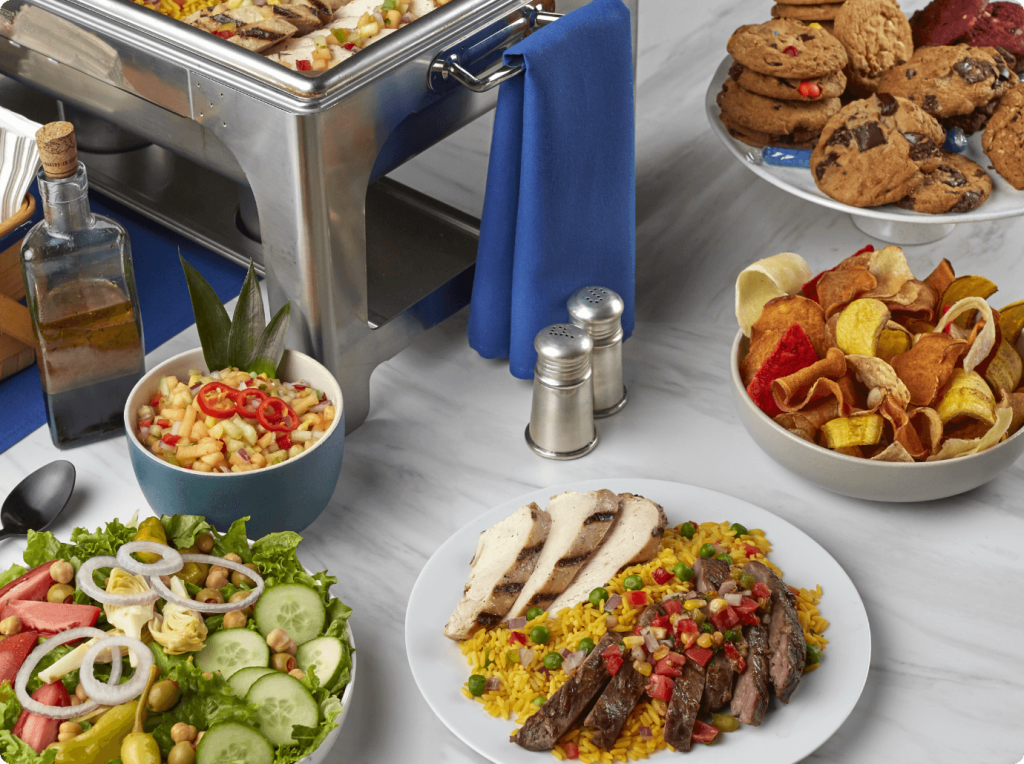
Corporate events require precise coordination, where multiple elements must align to ensure smooth execution. Among these, catering plays a central role, influencing both guest experience and operational flow. Managing food delivery, setup, and cleanup in-house can add unnecessary complexity and delays.
Full-service catering addresses these challenges by handling the complete food service lifecycle. With structured planning, timely delivery, and coordinated cleanup, it allows organizations to focus on event objectives while maintaining consistency in service delivery and presentation.
According to the National Restaurant Association, the foodservice industry- including catering –continues to grow as businesses¹ increasingly rely on external providers to manage food operations for events, highlighting efficiency and time-saving benefits for organizations.
Key Takeaways
- Full-service catering manages delivery, setup, and cleanup
- Coordinated logistics reduce delays and improve food quality consistency
- Professional execution supports efficient and organized corporate events
Coordinated Delivery for Timely Execution
Reliable delivery is a critical component of any catering system. Full-service catering providers operate with structured logistics to ensure food arrives on schedule and in optimal condition. This includes route planning, time coordination, and handling of venue-specific requirements.
Key operational elements:
- Scheduled delivery aligned with event timelines
- Temperature-controlled handling to maintain food standards
- Coordination with venue staff for smooth access
Why this matters
Timely delivery ensures that food is served at the correct temperature and reduces disruptions during setup.
Structured Setup and Professional Presentation
Once delivery is completed, the setup phase defines how efficiently guests can access and consume food. Full-service catering ensures that all elements are arranged in a structured and functional manner.
What professional setup includes
- Strategic Layout
Food stations are arranged to improve movement and reduce congestion during service. - Clear Presentation
Items are displayed in an organized format with proper labeling and alignment. - Complete Setup Components
Includes serving tools, utensils, plates, and necessary condiments.
Example Setup Efficiency Table.
| Component | Standard Setup | Full-Service Catering |
|---|---|---|
| Food Arrangement | Basic Placement | Structured Flow Design |
| Serving Materials | Partial or missing | Fully included |
| Guest Experience | Inconsistent | Organized and smooth |
| Setup Time | Longer | Optimized and effecient |
Additional advantages
- Reduces wait times during serving
- Enhances overall guest flow
- Supports professional event presentation
Food Safety and Handling Standards
Maintaining food quality requires proper handling before and during service. Full-service catering follows structured handling procedures to preserve freshness and reduce risk.
Key safety practices include:
- Temperature control during transport
- Use of sealed and insulated containers
- Timely setup to avoid prolonged exposure
According to food safety guidelines, maintaining proper temperature control is critical to preventing foodborne risks during events.²
Cleanup and Post Event Restoration
Cleanup is one of the most time-consuming aspects of any event. Full-service catering eliminates this burden by managing post-event restoration.
Cleanup process typically includes:
- Removal of all food and serving materials
- Collection and disposal of waste
- Organization of remaining food based on client preference
- Restoration of the event space
Why cleanup matters
Without structured cleanup, teams may spend additional hours managing post-event tasks. A coordinated cleanup process reduces downtime and allows teams to resume normal operations faster.
Service Efficiency and Time Management Benefits
Full-service catering consolidates multiple responsibilities into a single workflow. This improves time management and reduces the need for internal coordination.
Core efficiency benefits:
- Reduced coordination across vendors
- Faster execution of event phases
- Lower administrative workload
Process overview
- Event planning and menu selection
- Scheduled delivery and transport
- Setup and presentation
- Service execution
- Cleanup and site restoration
This structured approach ensures each stage follows a defined sequence, minimizing delays and inconsistencies.
Flexibility for Corporate Event Requirements
Corporate events often require flexibility in menu selection, dietary accommodations, and service style. Full-service catering supports these needs through adaptable service models.
Common flexibility features:
- Menu customization
- Dietary accommodations (vegetarian, gluten-free, etc.)
- Scalable service sizes for small or large groups
This adaptability allows organizations to maintain consistency while addressing specific attendee requirements.
How to Evaluate a Full Service Catering Provider
Choosing the right catering partner involves assessing operational capability and consistency in service delivery.
Key evaluation factors:
- Experience – Proven ability to handle corporate events
- Reliability – Consistent delivery and service timing
- Flexibility – Ability to adapt to event needs
- Communication – Clear coordination during planning and execution
| Evaluation Factor | Importance |
|---|---|
| Experience | Ensures consistent outcomes |
| Reliability | Maintains event schedule |
| Flexibility | Supports customization |
| Communication | Reduces planning gaps |
Role of Full Service Catering in Business Environments
Full-service catering supports structured business environments where timing, presentation, and coordination are essential. When integrating multiple service stages, it allows teams to focus on meeting goals and managing interactions.
Key contributions:
- Streamlined event execution
- Improved operational focus
- Enhanced guest experience consistency
Why Structured Catering Matters in 2026
With corporate events becoming more data-driven and time-sensitive, structured catering plays an important role in maintaining efficiency.
Choosing a Reliable Catering Partner
A strong catering partner operates as an extension of your team, aligning with your event objectives and execution standards. Providers like Corporate Caterers are structured to manage each phase of the process with consistency and coordination.
At Corporate Caterers, we pride ourselves on being that trusted partner. We understand that your focus should be on your business, not on catering logistics. From the moment you place your order to the final cleanup, our Catering Coaches are committed to providing a seamless experience that exceeds your expectations. Contact our Catering Coaches today to help with planning your next event.
People Also Ask
What is full-service office catering?
Full-service office catering includes food preparation, delivery, setup, service, and cleanup. It provides a complete solution that handles all aspects of food service during corporate events.
Why is full-service catering useful for corporate events?
It simplifies event logistics by combining multiple services into one system, allowing teams to focus on business activities while maintaining structured food service.
Does full-service catering include cleanup?
Yes. Cleanup is typically part of full-service catering and includes removal of food items, waste disposal, and restoring the event space to its original condition.
Footnotes
¹ National Restaurant Association. State of the Restaurant Industry Report. https://restaurant.org/research-and-media/research/industry-reports/state-of-the-restaurant-industry/